Niche likes Walther Ruttmann´s Berlin: Die Sinfonie der Großstadt.
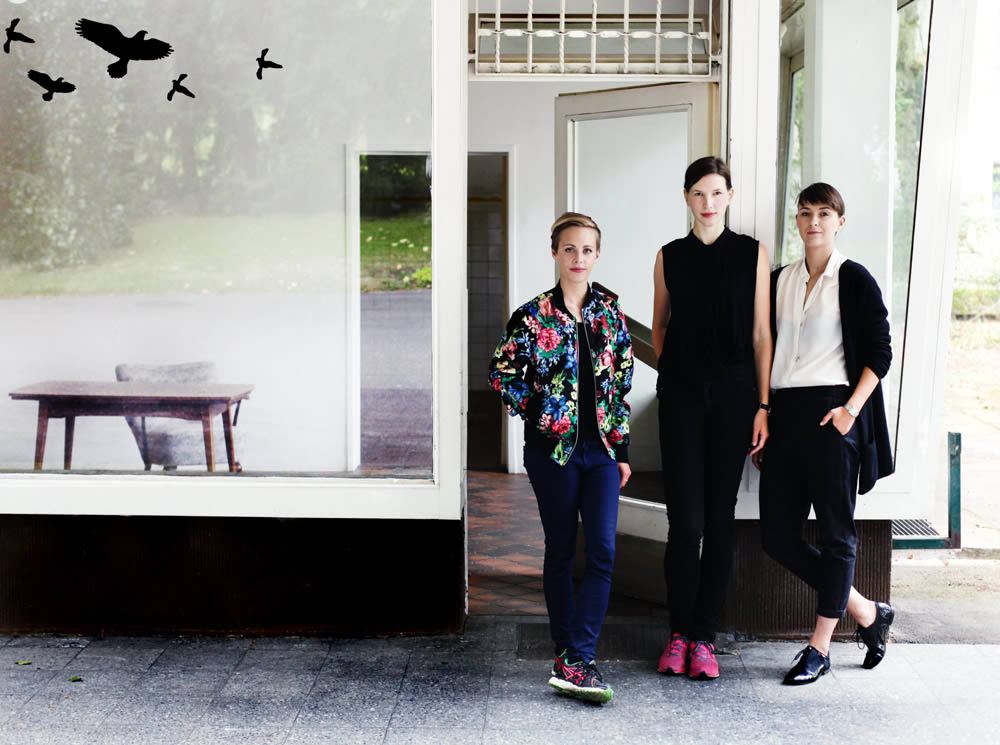
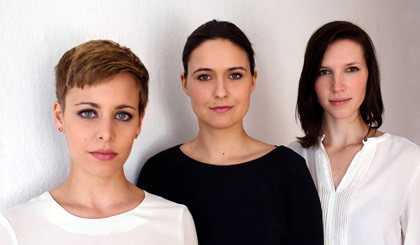
Niche art and architecture tours open up new Berlin perspectives. They offer inside knowledge for people wanting to experience the untouristy part of the city. Niche is the brainchild of Stefanie Gerke (art history), Nele Heinevetter (cultural sciences) and Katharina Beckmann (architecture), who watch Berlins alternative art scene and the architectural changings of the city closely and are happy to share their views with you - in German, English, French, Italian and Spanish.
Simply make your request here
Niche art and architecture tours open up new Berlin perspectives. They offer inside knowledge for people wanting to experience the untouristy part of the city. Niche is the brainchild of Stefanie Gerke (art history), Nele Heinevetter (cultural sciences) and Katharina Beckmann (architecture), who watch Berlins alternative art scene and the architectural changings of the city closely and are happy to share their views with you - in German, English, French, Italian and Spanish.
Simply make your request here

Berlin has much more to offer than the well-advertised museums and galleries. Hard-to-find project spaces and artist-run galleries with unique programming or particular financial strategies make Berlin such a special art metropolis. Niche offers individualized guided tours to these unconventional locations. It showcases art that has yet to be discovered and presents noteworthy exhibition concepts. Take an art tour.

Berlin’s architectural landscape is not restricted to historical buildings and startling new designs. The creative re-usage of existing structures and vacant spaces leads to astonishing and intelligent new projects that make the city’s core so distinctive. Niche puts together individual sightings of fascinating temporary structures as well as extraordinary conversions and explores their history. Take an architecture tour.

Quick overview or intensive survey? Art spaces or architectural sites? Special demands, requests or annotations? We organize unique tours according to your interest for small groups of around six people. Just ask for an offer, without any obligations:
*For a basic tour of around four spaces with a subsequent discussion you should schedule approximately two hours. On demand we are also happy to design day programmes for institutions or companies. Drop us a line: contact [AT] nicheberlin.de .
Niche likes Walther Ruttmann´s Berlin: Die Sinfonie der Großstadt.
Ever seen a chicken fry potatoes in an art space? Us neither. Not until day four of Six Days of New Media, an exhibition project by David Barbarino, Friederike Hamann, Moritz Hirsch, Pola Sieverding and Ulrich Urban. The evening was dedicated to sculpture and installation. Baldur Burwitz presented »Heisser Feger« (loosely translated: »hot chick«) – a huge chicken robot with a motion sensor, dropping fried croquettes onto the art space floor.

Neither had we ever seen a barrow coming to life by being transformed into a speaking mini motorcycle, reading passages of artist Nik Nowak’s China trip diary.

Nor a picture rewarding its viewers by playing the guitar, as seen in Claus Elzholz’s installation.

On the same evening, we stumbled over a motion sensored drawing machine at the promising new MMX Open Art Venue by Patrick Timm.

Machines everywhere. Seems like they’re taking over art as well. At least they did a good job!
Pictures: Stefanie Gerke
This weekend, altough Paris was visiting, we decided to dedicate ourselves to art spaces in our hood. We were greatly rewarded at FMAB and Feinkost, two galleries we fancy – although commercial – for their program and location.
In their quite hidden first floor apartment, FMAB – Fridey Mickel and Ariane Blankenburg – showed »Eclectic«: works by Amelie Groenzinger and Viola Lopes. Groenzingers large everyday material sculptures from cables, tree branches. wire and audiotapes are remarkably present and, being hard to grasp, challenge one’s imagination. The surreal photography of Lopes, shot with nothing but nighttime light resources, are very poetic stills of quite banal objects such as scaffolds. Their vivid colours make them simply beautiful.
32 year old Pittsburgh native Fridey Mickel has been involved in the Berlin art scene for about seven years now: She used to run Lifebomb, a Wedding based project space, before she opened FMAB in September 2008.

Viola Lopes: What a difference a day makes.
Gallery owner Aaron Moulton only came to Berlin in 2007. Together with Mette Ravnkilde Nielsen he runs Feinkost gallery, located in a former delicatessen store in a charming 50’s pavilion on Bernauer Strasse.
The current show, »Hierophania« by Italian artist Cristiano Mangione, consists of a series of works on canvas, paper and aluminium that look both delicate and brute at the same time. Whether the linen is lined by gesso flakes and flimsy strands, the ink of ballpoint pens turns paper into an iridescent oil slick or the fissured surface of the aluminium testifies the meticulous yet violent intervention of the artist: Their sheer beauty is breathtaking. We strongly recommend contemplating in front of these poetic yet obsessive works.

Cristiano Mangione: Untitled. 2009. Ballpoint pen on paper, 50x42cm.

Copy & Waste has scheduled two additional performances of its play ›Die Versteigerung von No. 36‹ that we highly recommend to see. We can’t think of any better location for the play than the run-down former dentist’s office WestGermany. The fancy performance by great actors matches the hilarious plot: Based on Thomas Pynchons ›The Crying of Lot 49/Die Versteigerung von No. 49‹, Oedipa Maas has to enforce the testament of her ex-lover, Berlin’s infamous Kottbusser Tor. In 2029, the so called ›Kotti‹ has been killed by »art, bohemia and strollers«. Oedipa errs around Neues Kreuzberger Zentrum, the massive 70’s building at Kottbusser Tor, trying to understand whether demolition or renovation would suit Kotti’s last will. Meanwhile, the mysterious acronym ›w.a.s.t.e‹ seems to be everywhere…


December 14th and 15th, 2009, 9pm at WestGermany, Skalitzer Straße 133, Berlin.
For tickets, simply email ticket@copyandwaste.de.
Some of you may have already seen (pictures of) the facade of the recently opened gallery and studio building designed by berlin-based architect Arno Brandlhuber in Brunnenstrasse. Reusing the already existing base plate of an ›investor’s ruin‹, he created something that is best described as a ›vertical teutonic favela‹. The architect used most of the material in a kind of rough way to try and keep the spaces simple. His plan was to give the inhabitants the freedom to design their environment on their own.
What excites us the most though is hidden for most passers-by: the very dynamic movement of the stairs in the backyard. They connect the building’s different levels while creating a sculpture of their own. Unfortunately, according to German building law, nobody will be allowed to use the stairs without a proper handrail. Hopefully the architect will find a way to keep their shape albeit security measures. New photos will follow.

The Koch Oberhofer Wolff-Gallery building is located in Brunnenstrasse 9, 10119 Berlin.
It’s neither in Berlin, nor niche-y, but still worth at least mentioning: The 53rd Venice Biennial. With a lot of room-filling installations.

from Elmgreen & Dragset’s danish nordic pavillions

Hans-Peter Feldmann’s ›Shadow Play‹

Moshekwa Langa’s ›Temporal Distance (With Criminal Intent). You Will Find Us in the Best Places‹

Darìo Escobar’s ›Kukulkan‹
From the last days of the Biennial, on display until November 22nd. Pictures by Stefanie Gerke
Why is it that so often lately in alternative exhibition spaces the buildings themselves seem so much more exciting than the art they display?
The Alte Post Neukölln - a former post office - is a turn-of-the-century brick building whose inside was restructured in 1980. It looks accordingly. The exciting plastic cylinder-shaped ceiling speaks for itself.
Yet the ongoing exhibition ›Consciences and frontiers‹ does not really pay tribute to the space. Curators Bonaventure Ndikung and Simone Kraft have assembled various positions dealing with internal and external barriers. It would have been nice to see more cooperation between artworks and space.
Remarkable exceptions are three installation works by Berlin based artist Surya Gied. The site specific installation ›Jenny’s Zimmer‹ makes you crawl through a small opening just to find yourself in a room without anything but dirty steps and old cables - at least that’s what you think until you turn around: the wall with the hole is the artwork – MDF boards, oil painted and taped. Without the painting, the room wouldn’t exist.


Gied’s installation ›Up‹ is similar in style, just that it constitutes a low ceiling and thus makes you look up - showing the sharp contrast between the linear oil strokes and the before mentioned cylinder shaped plastic ceiling.

Finally, her painting ›Schokolade braun‹ found just the right niche in the brick wall: the pastose mortar between the bricks highlights the drops of dried paint on the canvas.


That’s why we love these re-used buildings: In a white cube, none of the works would have had the same impact.
Alte Post Neukölln, Karl-Marx-Str. 97/99, on display until October 24th, 2009.
1965, Düsseldorf, Galerie Alfred Schmela: Beuys pours honey over his face, sticks gold leaf to it and locks himself into the gallery with a dead hare. He shows the public ›how to Explain Pictures to a Dead Hare‹.
2009, Berlin, no gallery: the artist group BANKLEER turns the whole performance around. A hare drags the ›dead‹ Beuys-like figure through the exhibition.

What a great way of examining today’s artistic positions in comparison to then. Especially when the performance is continued in other public spaces: on Friday, September 4th, the hare and his Beuys will go on a ›performative walk‹, starting at 3 pm at Temporäre Kunsthalle. Audience is welcome to join. A video documentation will show action and reaction on Sunday, September 6th, from 4 to 8 pm at no gallery.
During our city trip two weeks ago we had a glimpse on Prague’s young art scene. We couldn’t quite believe our eyes when we discovered FUTURA. Founded in 2003, the non-profit space is located in a former factory, has an artist in residency program, operates partnerships with other spaces and institutions and last but not least shows great art. There were works to see in literally every angle of this three-floor building offering a 1000sqm exhibition space.
The group exhibition The Eventual – curated by Eva Gonzales-Sancho, FRAC Bourgogne’s director - consisted of eleven works ranging from video, sound sculpture and text to site specific installations. Somehow all works dealt with the idea of the public observing the work, thus involving it thoroughly. In the basement we found Matthew McCaslins ›A Walk Threw the Woods‹ (2002). Aluminium poles obstructed the passage to a video projection you could only hear the sound of. Once you crossed the somehow menacing bars you saw the screen on which two men were gradually covering a tree with strips of paper to afore heard sound of a brisk wind, which made the paper seem like it was dancing.

MATTHEW MCCASLIN: A WALK THREW THE WOODS, 2002.
We also loved Guillaume Leblon’s beautiful sculpture ›Grand Chrysocale Mirroir‹ (2007). What looked like gold was a copper, zinc and tin alloy, called chrysocal, that here seemed to gently envelop a large mirror – protecting and hiding it at the same time. Large but fragile, the work was one of our favourites.

GUILLAUME LEBLON: GRAND CHRYSOCALE MIROIR, 2007.
Francis Alys’ subtle video installation ›Untitled‹ (New York, September 2000, 2001) was interesting as well. The work consisted of a static shot of Manhattan changing its appearance only slowly on the basis of the sun’s appearances and the lighting of buildings. The record player beside the screen played a Boogie Woogie recording as a tribute to Mondrian’s painting Broadway Boogie Woogie. You had to pay some attention. But the moment you discovered the ›picture‹ slightly changes constantly – you wouldn’t take off your eyes anymore.

If you ever go to Prague – don’t skip FUTURA!
The Art Biesenthal is an exhibition project in Michael Heckens beautiful villa in Brandenburg. About an hour from Berlin’s center, the former mill complex was transformed by Zanderroth Architekten. Every year, artists are invited to exhibit in or around the house – this year, the artist Paul Ekaitz decided to work ON the house. His hinges, called ›Spaces‹, are a great reflection of how this place works: it feels like a very open house, unshut, unconcealed, frank and open minded. From the backside, it already looks like you cannot hide anything in it, now this feeling is underlined by the hinges that suggest further opening. What a great site specific work of art.


If you feel like going on a day trip: this is definitely worth the while. Other participating artists are: Thorsten Brinkmann, Gregor Hildebrandt, Alicja Kwade, Via Lewandowsky, Bosse Sudenburg and André Tempel amongst others. Have a look on the website for more information.
It’s a great attitude of one of the most reknowned gallerists in Germany, Judy Lybke from Eigen+Art, to show and support unavowed up and coming artists that aren’t part of his usual portfolio. His latest exhibition LABOR (as in laboratory) features Yvon Chabrowski, Nahla Küsel, Adina Popescu, Anna Schimkat, Luise Schröder, Shonah Trescott and Kathrin von Ow.
We favoured the media reflective work of Yvon Chabrowski who makes her protagonists reenact scenes that are part of our collective memory. The photography Entführung (2007) cites the picture of terrorists posing next to their victims – only that here they are westerners wearing their normal clothes and – although pretending to hold a weapon – are unarmed. By the obvious studio setting, questions about representation and authenticty are being raised.

Same principle, different context: in Chabrowski’s video work An interview with H.R.H. The Princess of Wales a girl re-enacts, again in a studio environment, the answers Lady Di was giving in her last interview. The questions are not being asked so the spectator needs to fill the gaps by himself.

The multi-media show combines reflections on community and war or terror in all the works in a very subtle way.
It will be on display at Eigen+Art until September 5th 2009.
top picture: Yvon Chabrowski, Entführung, 2007, C-Print, 200 x 240 cm, edition: 3 courtesy Galerie EIGEN + ART Leipzig/Berlin
bottom: Yvon Chabrowski, still from An interview with H.R.H. The Princess of Wales, 2008, DVD, 63 min, edition: 8, courtesy Galerie EIGEN + ART Leipzig/Berlin
Just in case you’re interested in what we’ve also been up to during the last couple of months…
As if Berlin didn’t offer enough possibilities for spending the weekend yet: The following three days will be packed with interesting ›niche-y‹ art events.
48 Stunden Neukölln, apparently »Berlin’s biggest art and culture festival«, will prove that the district has more to offer than Kebab-shops and problematic schools. It will be a good opportunity to double check if this borough is really as up and coming as is being said.
Several artists are also opening their studios for Moabiter Kulturtage. Until the 28th of June, over 200 events and 50 exhibitions are taking place.
Neukölln, Moabit… another problematic but developing district shouldn’t be forgotten: Wedding. ›Kolonie Wedding‹ is hosting Junikolonie in the Soldiner Kiez. Also until Sunday 28th, exhibitions, parties and plays can be witnessed here.
Another event probably well worth seeing will be the Breakthrough Saturday. Evolving around General Public and Styx Project Space amongst others, it is being described as »an experimental 12 hour event distributed across Berlin locations, inter-network and radio space from 12 to 24h. Self-organising nodes construct an event occupied with the dislocation of representation (language, software), time and space […].« Should be good, especially as it’s being supported by the Hauptstadtkulturfonds.Enjoy the weekend!

The world famous Art Basel only from the outside… I was the only fool who followed instructions and left their camera at the cloakroom. Sorry, no pictures from in there! But enough of those have been published in newspapers – I want to share other impressions with you.
Already on the train to Basel I could tell who was going to the fancy art fair: You recognize these people from their very distinctive, slightly extravagant looks. At the sacred site, I was surprised by this year’s quality of the displayed works. It seems like no one dared to bring mediocre pieces in times like these. I saw a lot of installations, some painted walls instead of white cubes, a lot of mirrors (is that a way of saying: Look at yourselves!!?) and sculptures this time.
But at Art Basel you can’t help but feel like it’s just a big marketplace for things that have already been discussed. The artists have made it, the galleries are hyper professional, the works super expensive. Of course, you get quality and big names. Picassos, Miròs and Warhols, also younger shooting stars, but stars they are.
What amazed me more was the cool scenario of the Liste, the ›young art fair in Basel‹ in the former Warteck brewery.


Of course the hosting of an art fair in an old industrial building is nothing new. But it felt so refreshing again, so exciting to be on the hunt for something new around the next steel corner and up those steep stairs. Not everything displayed was good in my opinion, but here you felt something was happening. The communication between the works and the place really got to me. Especially the special exhibition by Kunsthalle Bern was fantastic. Entitled ›You don’t have to understand everything we do to profit from it‹, it was embedded in a print factory. Art woks and machines were displayed hand in hand. In the picture below you see Stefan Brüggemann’s writing ›Thoughts are products‹ together with a part of Bradley Pitt’s installation ›The Darkness in Between‹ that strangely lightened the place with LED light but left the spectator, who could (hardly) see himself in the monitor by means of the camera pointing towards him, in almost complete darkness. A play on visibility. The machine in the foreground is NOT art.

Another discovery was the temporary rooftop ›Milk and Wodka Buena Vista Freakshow Bar‹. Having taken 108 dark steps up into tower, I was awarded with a great view and the fun decoration and self made bar by the homonymous artist’s collective. A real niche. Art, maybe not high-end but high up in the sky.


As we offer tours to not-so-well-known places of artistic and/or architectural interest, we are always on the lookout for places where both come together in a special symbiosis. On our tour to interesting industrial sites in Berlin-Wedding, we found the ›Uferhallen‹.

Founded in 1898 by the ›Große Berliner Pferde-Eisenbahn-Actien-Gesellschaft‹ as a depot, the area was enlarged and rebuilt by Berlin’s public transportation company ›BVG‹ in 1928. Till 2006 the buildings were used to service their vehicles. Having seen different kinds of means of transport, the Uferhallen are an important testimonial for the evolution of public transport in Berlin. These ex storages are really nice huge brick houses, today reused as a place for cultural activities by the so called ›Uferhallen AG‹. Various exhibitions, dance shows and concerts have been hosted here.
First we were just amazed by the reuse of the old brick houses as a new cultural hub, but looking closer we found some nice details of the existing architecture transferred into installation-like objects:

We spotted these windows packed with insulating material. Don’t you get the impression that the building is nearly bursting? By losing its old function, the garage has changed into something new, something more sculptural. We specially liked the composition of colours and the idea of a vanished space inside, lost because it has been filled. Imagine what it must feel like to try to find your way through an ocean of yellow insulation. (By the way: yes, it’s just window insulation and its is not filling the whole space inside. But we think that especially when you find yourself in this evolving district, ›im Wedding‹, things can be seen in a new and maybe more poetic way).
Another enthralling example of an interesting conversion is the neighbouring ex bus stop. It now serves as a huge letterbox for the companies and artists based here. If you look closely, you’ll find some important names there. Monica Bonvicini is just one of them.

Short follow-up on our article on Cruise & Callas: In this gallery, every artist accompanies their show with an affordable art edition. The artist Sibylla Dumke presented the full range of her mobiles last Thursday. They transpose Dumke’s painterly approach into tridemensional objects. The flat surface of her canvases is dissolved. Colourful geometric forms joined by transparent plastic strings form intriguing ensembles: Moving in the air current the pieces of plastic and cardboard change colour and therefore the whole character, offering a varied spectacle. A childhood toy gone arty!
And now imagine the effect a set of mobiles spread over the whole exhibition space has on its surprised spectator…

It was tough, but in the end we decided on one and are now proud owners.
If you’re intrigued: I’m sure there are still some for sale. Just call the Cruise & Callas ladies Simone Lüling and Kirstin Strunz. Their upcoming exhibition is called: ›Stefan Rincks Lehrplan des Lebens - Life would suck without it‹, opening June 5th. The title is reason enough to go see it!
Berlin has loads of these interesting galleries, project spaces and hidden architectural treasures. If you want to know more about them, you can book a Niche Art & Architecture Tour with us!
C/O Berlin is currently showing some interesting photo works. While their beautiful location is not in our niche portfolio due to the fact that it’s already so well known, they are showing, amongst others, a niche-y series of pictures by American artist Taryn Simon (*1975 in New York): ›An American Index of the Hidden and Unfamiliar‹.
The artist does what we do: look for the unexpected. Except that we concentrate on art and architecture. Simon spent a couple of years taking pictures of unusual places and things in the US. But these aren’t the ›usual unusual‹ kind of photos with funny people in strange poses: They take you into a bizarre cabinet of wonders. If you go see the show, you’ll discover a Braille Playboy issue for blind people, the place where transatlantic submarine cables hit the continent, a cage with a white tiger that is mentally and physically retarded due to overbreeding and the place where unallowed, smuggled food is taken from travelers at U.S. Customs and Border Protection - nasty. But very interesting. Who would have ever expected someone really trying to import a South American pig’s head into the US?

Taryn Simon: Playboy, Braille Edition.

Taryn Simon: U.S. Customs and Border Protection, Contraband Room.
C/O Berlin, International Forum For Visual Dialogues, presents the exhibitions Visions of our time and the Deutsche Börse Photography Prize 2009 from May 29th to July 19th, 2009. All photos © Taryn Simon with kind permission of C/O Berlin.
Last Tuesday, two new shows opened at General Public, an independent project space »run by a group of cultural workers«, located on Berlin’s Schönhauser Allee.

›Undigested Kernel (the super-saturated folk-art environment)‹ presents huge black and white wall paintings by US-based tattoo artist Scott Harrison. On those, the spectator finds the more multi-layered exhibition ›Alle Herzen fliegen zu‹.

Both exhibitions are shown at the same time on the same walls. Scott Harrison’s large scale skeletons and somewhat distorted animals leave a rather brusque (and yes, undigested) impression. The contrasts are bright, the surfaces are plain and the scenes are absurd: like a bearded carcass playing ice hockey. In return we were surprised by the rather small works the group show gathered and presented upon Harrison’s work. Playing with the notion of drawing in all possible aspects, the underlying materiality and the role of handcraft, ›Alle Herzen fliegen zu‹ assembles a broad range of artistic approaches: works on paper, enamel or tissue, made by hand or on the computer, drawings, paintings, writings and assemblages. The supplementary title ›Zeichnungen und Servietten plus Diverses‹ (drawings and tissues plus miscellaneous) says it all: There was a lot to discover.
How did these completely different exhibitions fit toghether? The story is quite simple: General Public invited the tattoo artist Scott Harrison, who was not terribly interested in having a solo art show. He decided that other works could be hung upon his wall paintings. And that’s what happened. The second exhibition combines various coups de coeur of the curators Cristina Gomez Barrio and Wolfgang Mayer. It shows surprising interactions with the walls they’re presented on. The contrast between the large paintings and the smaller, more subtle works emphasises both approaches.
We really liked the colour contrast between Ulrike Müller’s neon kind of kidney shaped painting and Scott Harrison’s ›Ja, ja‹:


Also, the curators chose an intresting text-based work by the painter Amy Sillman, represented by the gallery Carlier Gebauer: it consists of a simple chart, tracing some characters that are gathered around a table for a fictive (or non? you never know) Frieze dinner. Very fun to read. And probably a little true.


Last, the idea of authorship, art and handcraft culminates in the works of Jan Rohlf. A very impressive drawing made by hand that looks alomst mechanical is shown across from works he actually designed digitally. The minute differences trigger a chain of thought evolving around such discourses as man vs. machine. Pretty big subjects for such small works.

The artists presented in this show are
Ulrike Müller
Michael Mahalchick
Amy Sillman
Cristina Gomez Barrio
Catriona Shaw
Urania Fasoulidou
Wolfgang Mayer
Berthold Reiss
Anne Roessner
Jan Rohlf and
Discoteca Flaming Star.
Both exhibitions will be displayed from May 20th to June 7th, 2009 at General Public.
Informal can mean ‘without form’ and ‘casual’. Belgian artist Jofroi Amaral and his ‘informal_space’ near Helmholtzplatz in Berlin exploit this confluence of meanings: In his curated show ‘sine lumine pereo’, Francisca Würz, Roland Moreau, Katharina Kritzler, Pierre Granoux, Roland Fuhrmann and Jofroi Amaral himself showed mostly abstract pieces. The works were for sale but still this is no typically commercial space: Amaral’s laid back approach results in the fact that he shows whatever he likes whenever he wants.
His show surprised and convinced us. As the title suggests, the exhibited artworks played with light. But playing might be the wrong word here, as there was nothing playful about the quality of the artworks. Some had technical or scientific, some had metaphorical approaches to the subject - and they were pretty well executed.


Amaral’s cube ‘lumen hermeticum’ (in the first picture and below) apparently has its very own bulb shining inside, a statement we have to trust as there is no way to see it. This opens up a lot of philosophical questions and associations, from the ‘light in the fridge’ questions to Plato’s Cave Analogy.

Amaral’s piece “Neon sprayed onto” consists of a neon glow lamp with black spraypaint on the side facing the viewer. The fact that the black paint suddenly leaves its tracks to be found in a curve on the wall behind the lamp seems to call upon associations of getting blinded, of not being able to fight or hide the power of the light or of something getting lifted up by it.

There were many other artworks in this exhibition that were worth the while. They were only on display up to this week but you can find more information on the homepage. We’re excited to see the next show in this ‘informal space’: Apparently, it’s gonna be on race bikes as art works. Nothing too formal about that!
All pictures by Katharina Kritzler with the kind permission of Jofroi Amaral, taken from www.jofroi-amaral.com and www.informal-space.com.
Niche GbR
Rheinsberger Str. 68
10115 Berlin
Germany
Phone: +49 1635380149
contact [AT] nicheberlin.de
tax ID: 34/221/51968
Design & Website: Uli Schöberl